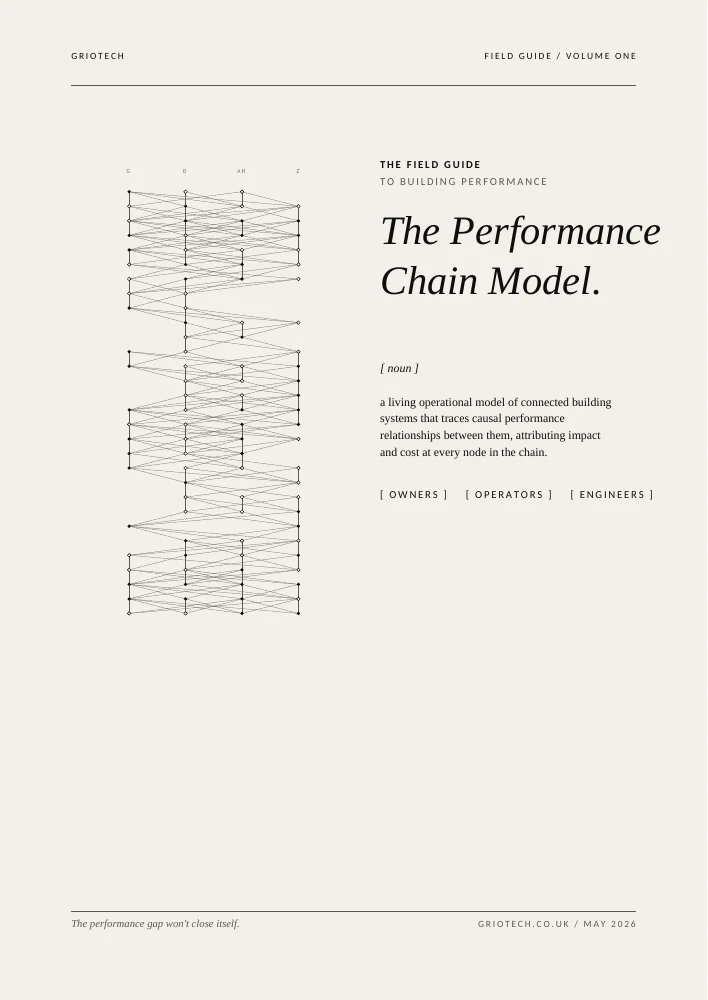
The Performance Chain Model
A connected model of generation, distribution, air handling and zones. Seven chapters on system boundaries, performance assessment and tracing operational impact.
Read the guideGRIOTech / Resources
Engineering ideas, examined in detail. Publications and practical investigations on how buildings behave, how evidence is interpreted and how performance can improve.
Supply air reads warmer than mixed air while the heating valve is commanded closed. Follow three alternative explanations through the same connected HVAC system.
Explore the walkthroughAn engineering collection
Long-form thinking, with room for the detail. Read online or request the complete PDF edition.
A connected model of generation, distribution, air handling and zones. Seven chapters on system boundaries, performance assessment and tracing operational impact.
Read the guide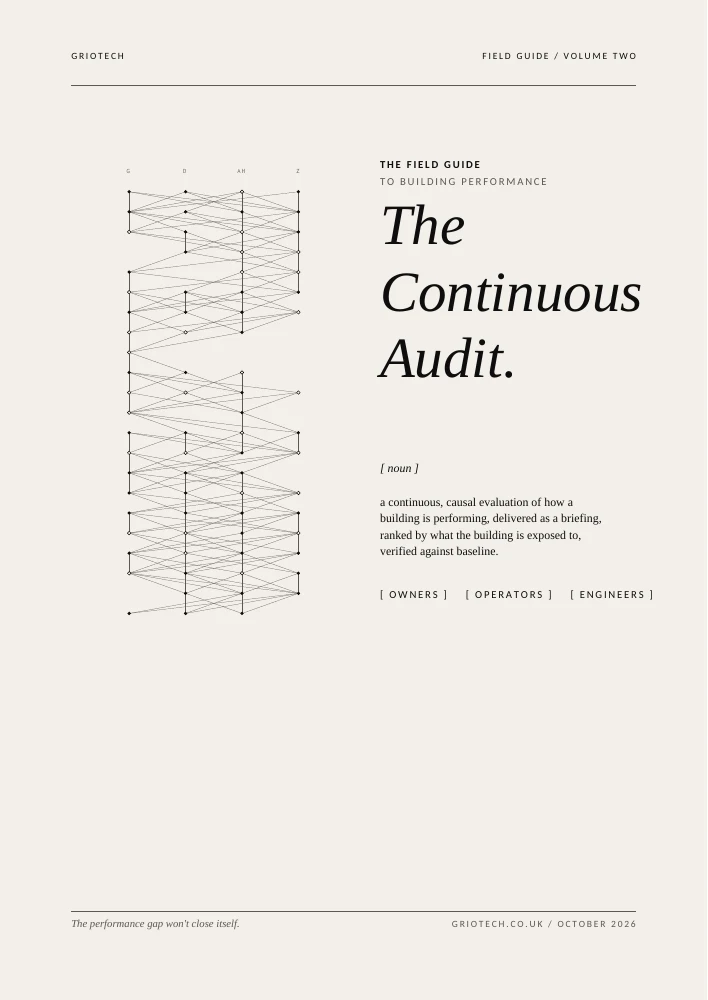
What it takes to move from describing performance to evaluating it continuously: causal understanding, operational exposure, clear briefings and verified outcomes.
Second edition · October 2026.Read the guide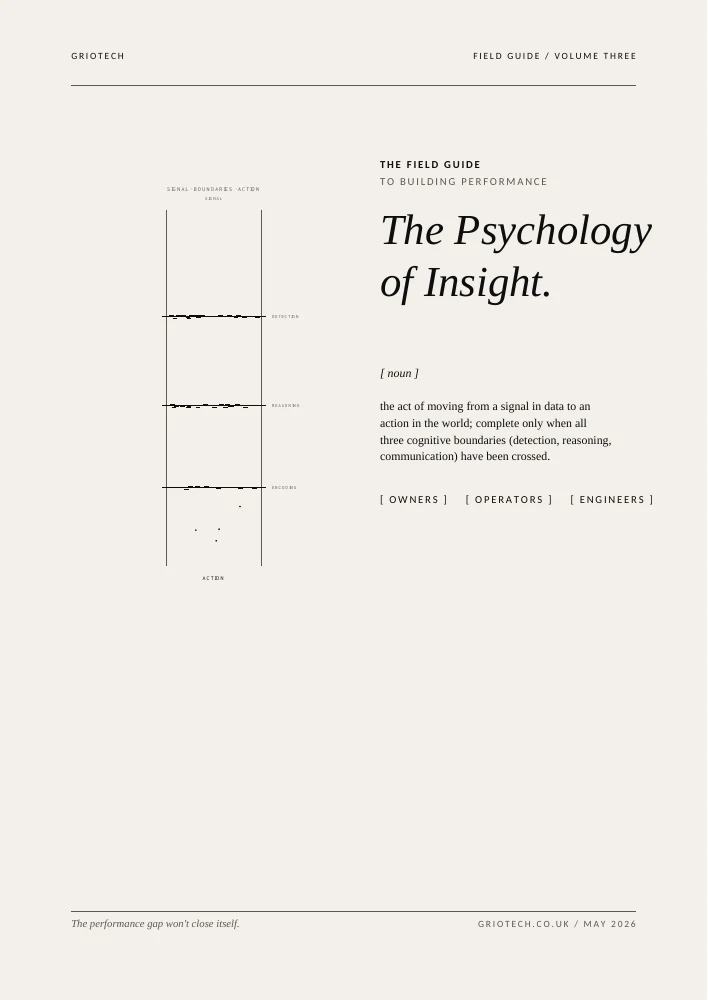
Noticing, interpreting and encoding: three cognitive boundaries between a signal in building data and an action in the world. A framework for diagnostic systems, with a worked sensor investigation.
Read the guideResearch / Standards / Engineering methods
ABIE is built around established engineering principles, independent research and defined assessment methods.
Explore the studies, standards and professional guidance that inform our approach to understanding building performance — from operational faults and energy modelling to system relationships, exposure and verification.
These references support different aspects of the approach. ABIE’s own assessment and scoring methods are developed by GRIOTech and are not certified or endorsed by the organisations listed.
16 references / curated
Examines reported FDD savings alongside ways to assess diagnostic-algorithm performance.
Relevance to ABIE Helps explain why fault detection needs repeatable evaluation as well as evidence of operational benefit.
View original publicationThe publisher reports 26 organisations using FDD across 550 buildings and 97 million square feet, with median savings of 8%. The study also develops a repeatable evaluation method and trials it on three sample FDD algorithms.
Guanjing Lin · Hannah Kramer · Jessica Granderson
A participating-user study does not establish the accuracy or savings of ABIE. Diagnostic test performance and achieved building savings answer different questions.
The public abstract does not state a common observation period or savings-normalisation basis. The reported cohort result is not an annual savings forecast for another building.
Publisher checked 2026-10-26. Publication metadata and abstract: January 2020; Building and Environment 168; cohort and median savings.
DOI: 10.1016/j.buildenv.2019.106505
A retrospective study examines re-tuning in federal buildings and the practical work behind operating improvements.
Relevance to ABIE Connects operational understanding with control-system correction and engineering intervention.
View original publicationA retrospective study of 26 federal office buildings and courthouses reports average annual energy savings of 12.1% after low- and no-cost changes to building automation controls, despite relatively efficient baselines.
N. Fernandez · D. J. Taasevigen · R. M. Underhill
Re-tuning includes human investigation and corrective work. Its outcomes do not imply that monitoring or identifying a fault alone saves energy. Results are specific to the participating buildings and study boundaries.
Published March 2017. The public abstract reports annual savings but not the individual monitoring dates or adjustment procedures; consult the full study before transferring its result to another context.
Publisher checked 2026-10-26. Publication date, abstract and citation: March 31, 2017; Journal of Architectural Engineering 23(1); PNNL-SA-112623.
DOI: 10.1061/(ASCE)AE.1943-5568.0000216
A single office-building case study follows monitoring-based HVAC commissioning and subsequent operation.
Relevance to ABIE Shows why connected investigation, operating history and post-intervention checks belong together.
View original publicationAn existing office-building case identified economiser, simultaneous heating/cooling and optimal-start faults through trend analysis and functional testing. A calibrated simulation estimated opportunities; the publisher reports 10% actual energy savings after measures were implemented.
Shankar Earni · Spencer Woodworth · Xiufeng Pang · Jorge Hernandez-Maldonado · Rongxin Yin · Liping Wang · Steve E. Greenberg · John Fiegel · Alma Rubalcava
A single intervention is contextual evidence, not a general savings rate. Identified potential, implemented measures and measured outcomes must remain distinct.
Published October 2012. The public abstract does not specify the post-intervention observation period or measurement adjustments; 10% is the reported case outcome, not a general or necessarily annual savings rate.
Publisher checked 2026-10-26. Report metadata and abstract: October 2012; author list, identified faults, modelled opportunities and reported realised result.
Research on a systematic framework for evaluating building fault detection and diagnosis algorithms.
Relevance to ABIE Supports the distinction between detecting an unusual condition and establishing a reliable diagnosis that can be explained.
View original publicationProvides a structured way to consider fault definitions, test evidence and algorithm evaluation; no energy-saving percentage is attributed to this paper.
Stephen Frank · Guanjing Lin · Xin Jin · Rupam Singla · Amanda Farthing · Jessica Granderson
A diagnostic evaluation framework does not validate ABIE’s algorithms. Performance depends on the defined faults, test conditions, ground truth and evaluation boundary.
Publisher checked 2026-10-26. Publication metadata and abstract: June 2019; Energy and Buildings 192; fault and evaluation-sample definitions.
DOI: 10.1016/j.enbuild.2019.03.024
Guidance on the measurement of energy, demand and water savings.
Relevance to ABIE Relevant to expected-versus-actual energy assessment and checking outcomes after intervention.
View original publicationProvides procedures for comparing measured pre- and post-retrofit billing data to determine energy, demand and water savings within a defined facility or meter boundary.
ASHRAE Guideline 14-2023
Does not prescribe ABIE’s recoverable-value calculation or scoring. A consumption deviation is not automatically avoidable energy, and a modelled opportunity is not verified savings.
The published scope excludes large-scale demand-side-management sampling methods, metering standards and major industrial process loads.
Publisher checked 2026-10-26. Titles, Purposes and Scopes: Guideline 14-2023, Purpose and Scope including exclusions.
A commissioning-process standard for existing buildings and systems.
Relevance to ABIE Relevant to the evidence and accountability linking a finding, intervention and subsequent assessment.
View original publicationFrames commissioning as an organised process involving investigation, documentation and verification.
ASHRAE Standard 230-2022
A software work order is not a complete commissioning process. Referencing the standard does not demonstrate compliance or replace required professional commissioning work.
Publisher checked 2026-10-26. Commissioning bookstore: Standard 230-2022 description, minimum requirements and planning through initial ongoing commissioning.
Published foundations / GRIOTech implementation
Different aspects of building performance require different forms of evidence. ABIE draws on established engineering principles while applying its own connected assessment framework.
Explore the published methods and research relevant to each area.
A suitable baseline helps distinguish changing demand from unusual consumption. Defined boundaries, operating conditions and measurements make the comparison meaningful. A recoverable opportunity still needs an intervention; savings need subsequent verification.
A modelled deviation is not automatically avoidable energy or a measured saving.
Independent sources inform the engineering context. Referencing a standard does not certify ABIE or establish conformity with it.
Lawrence Berkeley National Laboratory · 2020 · Supporting evidence
Examines reported FDD savings alongside ways to assess diagnostic-algorithm performance.
A participating-user study does not establish the accuracy or savings of ABIE. Diagnostic test performance and achieved building savings answer different questions. The public abstract does not state a common observation period or savings-normalisation basis. The reported cohort result is not an annual savings forecast for another building.
View original publicationPacific Northwest National Laboratory · 2017 · Supporting evidence
A retrospective study examines re-tuning in federal buildings and the practical work behind operating improvements.
Re-tuning includes human investigation and corrective work. Its outcomes do not imply that monitoring or identifying a fault alone saves energy. Results are specific to the participating buildings and study boundaries. Published March 2017. The public abstract reports annual savings but not the individual monitoring dates or adjustment procedures; consult the full study before transferring its result to another context.
View original publicationLawrence Berkeley National Laboratory · 2012 · Supporting evidence
A single office-building case study follows monitoring-based HVAC commissioning and subsequent operation.
A single intervention is contextual evidence, not a general savings rate. Identified potential, implemented measures and measured outcomes must remain distinct. Published October 2012. The public abstract does not specify the post-intervention observation period or measurement adjustments; 10% is the reported case outcome, not a general or necessarily annual savings rate.
View original publicationLawrence Berkeley National Laboratory · 2019 · Supporting evidence
Research on a systematic framework for evaluating building fault detection and diagnosis algorithms.
A diagnostic evaluation framework does not validate ABIE’s algorithms. Performance depends on the defined faults, test conditions, ground truth and evaluation boundary.
View original publicationASHRAE · 2023 · Engineering alignment
Guidance on the measurement of energy, demand and water savings.
Does not prescribe ABIE’s recoverable-value calculation or scoring. A consumption deviation is not automatically avoidable energy, and a modelled opportunity is not verified savings. The published scope excludes large-scale demand-side-management sampling methods, metering standards and major industrial process loads.
View original publicationASHRAE · 2022 · Engineering alignment
A commissioning-process standard for existing buildings and systems.
A software work order is not a complete commissioning process. Referencing the standard does not demonstrate compliance or replace required professional commissioning work.
View original publicationASHRAE · · Engineering alignment
A proposed semantic data model, with official supporting resources, for describing building systems for analytics and automation.
ASHRAE’s titles, purposes and scopes register lists 223P as proposed. This is not presented as a dated, published standard or a claim that ABIE implements it. Direct implementation in ABIE has not been established. Semantic relationships do not prove causation, sensor validity or sufficient instrumentation, and do not define ABIE’s Observability score.
View original publicationASHRAE / ACCA · 2018 · Engineering alignment
A standard for inspection and maintenance of commercial-building HVAC systems.
A missing inspection or proof record does not by itself establish equipment failure; software assessment does not replace required inspection. The standard’s exclusions and applicable building/system scope must be observed.
View original publicationASHRAE · 2023 · Engineering alignment
A thermal-comfort standard addressing conditions for human occupancy.
Air temperature alone does not establish full ASHRAE 55 compliance. A representative service score is not a compliance result, and different services require different criteria.
View original publicationASHRAE · 2025 · Engineering alignment
A ventilation and indoor-air-quality standard for applicable building types.
A commanded fan state is not measured ventilation. An operational service comparison is not a complete compliance assessment or a substitute for applicable statutory or specialist validation.
View original publicationCIBSE · 2020 · Engineering alignment
Guidance on modelling and calibrating building performance to examine energy in use.
A calibrated model is not automatically an optimal-operation baseline. Model suitability, input quality and the comparison period affect what a deviation can establish. Primarily written for UK non-domestic buildings, with an office worked example. Other countries and contexts require appropriate adjustments.
View original publicationISO · 2023 · Engineering alignment
Guidance on energy performance indicators and energy baselines within energy management.
Does not prescribe ABIE’s proprietary performance indices or make them ISO-certified. Baseline adjustment and applicable operating conditions remain necessary.
View original publicationEfficiency Valuation Organization · 2022 · Engineering alignment
A measurement-and-verification framework for energy and water savings.
An estimate of recoverable opportunity is not a measured saving. Metering boundaries, adjustments, uncertainty and the chosen verification approach must be stated. EVO’s public overview verifies the 2022 Core Concepts reference and its M&V scope. The full document requires an EVO account and was not reproduced or reviewed here.
View original publicationBrick Ontology Project · · Engineering alignment
An open metadata initiative for representing building equipment, points and relationships.
Direct implementation in ABIE has not been established. No Brick certification is claimed; an equipment relationship alone does not prove an operating fault or causal effect. This entry refers to the undated project introduction, not a specific software release or the separately published research paper. No publication year or DOI is assigned to that web page.
View original publicationISO · 2018 · Engineering alignment
Guidelines for structured risk management.
ISO 31000 does not prescribe ABIE’s 0–100 Risk Exposure score or a universal failure probability. Context, evidence and the applicable consequence boundary remain essential.
View original publicationISO · 2024 · Engineering alignment
Requirements for an asset-management system.
This reference establishes neither ISO 55001 certification of GRIOTech or ABIE nor a prescribed algorithm for ABIE’s exposure scores.
View original publicationA suitable baseline helps distinguish changing demand from unusual consumption. Defined boundaries, operating conditions and measurements make the comparison meaningful. A recoverable opportunity still needs an intervention; savings need subsequent verification.
A modelled deviation is not automatically avoidable energy or a measured saving.
Read the supporting Field GuideAssessing service starts with what the building or system is required to deliver. Applicable comfort and ventilation criteria can inform that requirement when the necessary measurements and operating context are available.
An operational service assessment is not a complete ASHRAE compliance test.
Read the supporting Field GuideStructured risk and asset-management principles help connect an operating concern with its potential consequences, equipment importance and appropriate attention. The assessment needs a stated context and supporting evidence.
These standards do not define ABIE’s numerical Risk Exposure method.
Read the supporting Field GuideInspection, maintenance, commissioning and proof of performance provide different forms of assurance. Understanding what has been required, completed and demonstrated helps teams identify where further evidence or action is needed.
An unmet requirement or missing proof record does not by itself establish equipment failure.
Read the supporting Field GuideA reading is useful when its equipment, meaning and limitations are understood. Suitable instrumentation, structured metadata and testable diagnostic evidence help establish which assessments the available information can support.
Metadata is not proof of sensor integrity. These references do not define ABIE’s Observability score.
Read the supporting Field GuideKnowing which systems connect gives an investigation context beyond an isolated alert. Operating evidence and diagnostic evaluation help distinguish a possible origin from symptoms and supported consequences elsewhere.
A semantic or physical relationship alone does not prove causation. Attribute each distinct energy or financial consequence once.
Read the supporting Field GuideReading the relationship. Supporting evidence documents a published study. Engineering alignment identifies related principles. A method reference is reserved for a prescribed method confirmed in an ABIE assessment; relevance alone is not enough.
The library
Latest publications and updated editions first.
5 published resources
A chilled-water pressure fault leads to three possible explanations: sensor error, a hidden bypass or a restricted branch. Examine the evidence that separates them.
Chilled-water distribution / Diagnostic reasoningNew Field Guides, investigations and perspectives, when there’s something useful to share.
Checking subscription availability…
Engineering thinking, in practice
Explore ABIE’s connected view of building performance, or talk with us about your building.